Markets Reach for Gold First, but the Deeper Value Sits in Silver and Platinum

United States debt crossed $40 trillion this month. By itself that is unremarkable, but the manner in which the Treasury tried to reassure markets, by doubling the purchase of its own debt and claiming that deficits might have hit their peak, was troubling to many. When confidence in government debt wobbles, money instinctively reaches for gold first, and we have seen the price appreciate quite sharply of late.
But the more interesting opportunities sit in the two smaller precious metals: silver, still trading more than 40% below its January record, and platinum, a metal so scarce that the world mines one troy ounce of it for every 21 of gold, yet priced at a fraction of gold.
|
On 19 August, US federal debt crossed $40 trillion. The July deficit alone exceeded $432 billion, and net interest costs have reached $963 billion in the first ten months of the fiscal year. A week earlier, the 30-year Treasury auction cleared at 5.216%, the most expensive long-term borrowing for the US government since 2001, as buyers of long-dated US debt have been demanding increasingly higher returns.
In response the Treasury announced it would at least double its buybacks of 10-to-30-year debt to $4 billion per operation, with Secretary Bessent saying the purchases could go higher still. The world's largest debtor is now buying back its own long bonds to hold down its own borrowing costs. Officials describe it as liquidity support. Whatever the label, a sovereign intervening in its own debt market is a milestone, and markets treated it as one, with yields rising again and undoing much of the effect of the intervention. Ultimately the value of the dollar and of Treasuries rests on trust in the currency and on good management of the state. When a treasury buys back long-term bonds by issuing more short-term debt, that does not build trust, and that is what we saw. Gold rose nearly 5% that week to around $4,600 per troy ounce, its highest level since May.
Ray Dalio, the founder of Bridgewater Associates, drew the same conclusion within days. In a widely read post, he argued the buyback fits a pattern that historically precedes sovereign debt crises, noted the Treasury's limited capacity to keep buying, and put his estimate of the timing at "in three years, give or take two". His portfolio advice: underweight bonds, hold 10% to 15% in gold, and diversify into assets that governments cannot produce. CNBC's coverage is here.
As the case for physical metals becomes clearer to more people and upward momentum builds, it is a good time to take stock of which metals offer the best value relative to each other.
|
Gold moves first, because it is the deepest, most liquid and most institutionally accepted metal. But that is precisely why the larger percentage moves in a monetary metals cycle have historically come later, and lower down the size ladder, in the metals that are scarcer, thinner and slower to attract the first wave of capital.
| SILVER: STILL MORE THAN 40% BELOW ITS JANUARY RECORD |
Silver reached an all-time high of $121.67 per troy ounce on 29 January 2026, then gave much of it back in one of the most violent corrections in the metal's history. As of Monday 24 August it trades just under $70, more than 40% below that record even after rallying strongly this month. The fundamentals did not correct with the price. The silver market is in its sixth consecutive year of supply deficit, industrial demand keeps growing, and the metal remains, as we wrote in June, easy to buy at precisely the moment the structural argument for owning it is strongest.
| PLATINUM: THE SCARCITY THE MARKET HAS NOT PRICED |
Platinum set its own record of $2,920 per troy ounce on 26 January 2026, having finally broken its 2008 nominal high after seventeen years. It now trades around $1,890, some 35% below the January peak. Adjust the 2008 peak for inflation and it sits near $3,500 in 2026 dollars: platinum remains far below its real all-time high even after a strong year.
The supply picture is tighter than either gold's or silver's. The World Platinum Investment Council forecasts a fourth consecutive annual deficit in 2026, above-ground stocks have fallen below three months of demand, and roughly 70% of mine output comes from a single country, South Africa, where production has been constrained for years. Platinum is a small market in absolute terms, which cuts both ways: it is more volatile, and it needs far less capital to reprice.
|
Take the three metals' prices as of Monday 24 August, and set them against how much of each the world actually mines every year. We use silver as the base of 1, since it is the most abundant of the three.
| Silver = 1 | Silver | Gold | Platinum |
| Price, 24 Aug (USD/toz) | ~$70 | ~$4,605 | ~$1,890 |
| Price ratio | 1 | 66× | 27× |
| Annual mine output (approx.) | 820 M toz | 119 M toz | 5.5 M toz |
| Scarcity of new supply | 1 | 7× scarcer | ~150× scarcer |
Prices: spot, Monday 24 August 2026, rounded. Mine output: Silver Institute, World Gold Council and World Platinum Investment Council estimates for 2025, rounded.
For every gold ounce mined only 7 ounces of silver are mined, yet silver is priced at one sixty-sixth of gold. Silver is in its sixth year of deficits, and last October's severe supply squeeze in the London market showed how low global stocks have run.
Platinum is even more supply constrained: for every troy ounce of platinum produced, the world mines about 21 troy ounces of gold and roughly 150 troy ounces of silver. Yet platinum trades at 27 times the silver price and only 0.4 times the gold price. For most of modern history platinum cost more than gold; today it costs less than half as much, while running its fourth consecutive supply deficit.
|
The chart below shows daily spot prices for all three metals since 2000, both in the dollars of the day and restated in 2026 dollars using US consumer price inflation. The January highs marked on it are the intraday records quoted above, and the latest prices are those of Friday 21 August.
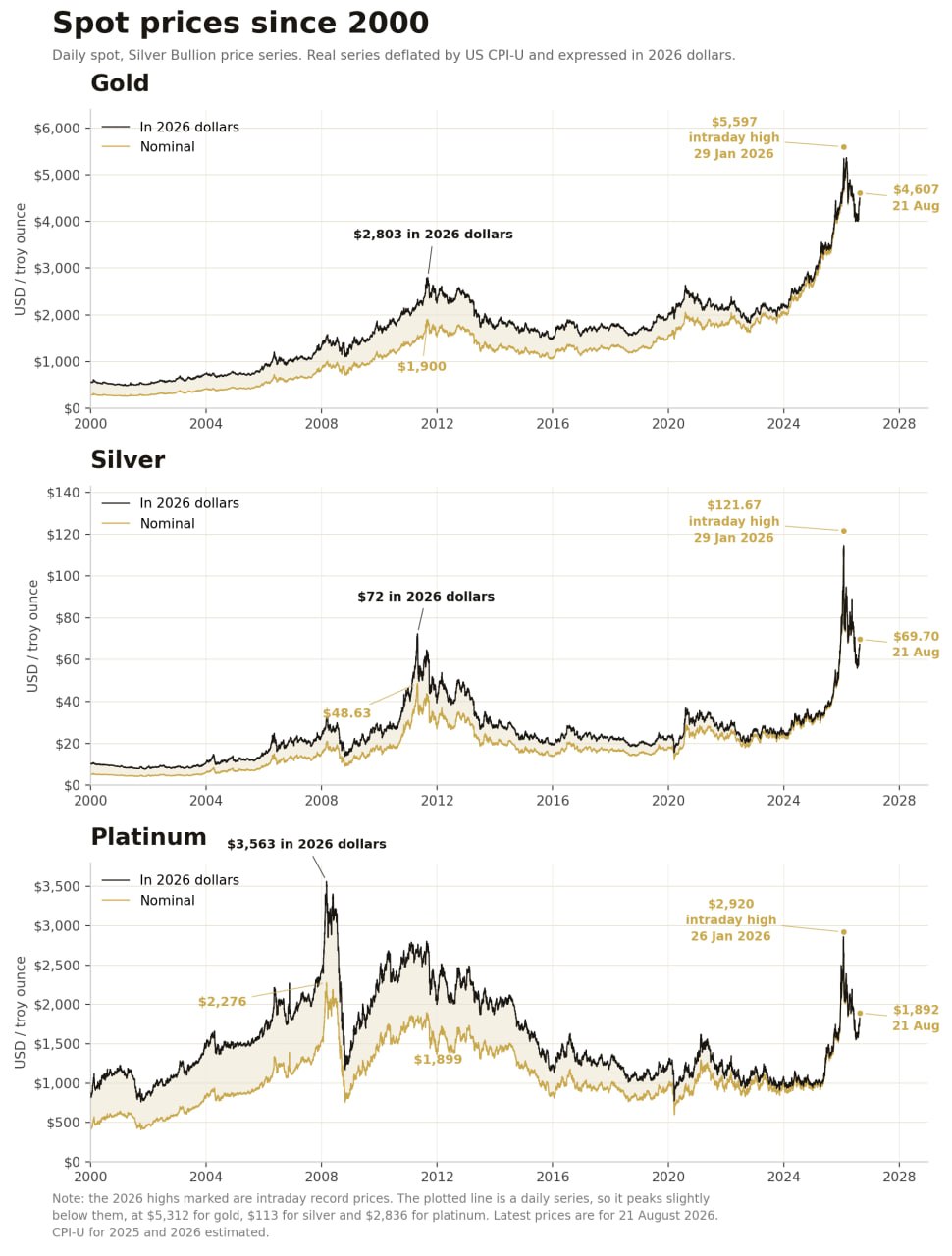
Gold has clearly repriced: its 2011 peak of $1,900 is $2,803 in today's money, and gold now trades well above that. Platinum is the anomaly on the page. It cost around $1,900 in 2011. It costs about $1,890 today. Fifteen years of monetary expansion and four years of supply deficits later, the nominal price is unchanged, which means the real price has fallen by roughly a third. Against its 2008 record of about $3,500 in 2026 dollars, platinum trades near half. Gold at these levels already prices in the monetary case. Platinum does not yet price in its own scarcity.
These charts are part of the reason why I am personally purchasing some silver and considerable amounts of platinum myself now. The drivers that cause gold to appreciate also largely apply to silver and platinum, but in my mind these metals have three additional advantages:
-
They are inexpensive. Silver has fallen more than 40% from its January peak and platinum some 35%, much more than gold.
-
The silver and especially the platinum markets are far smaller than gold's. It takes a great deal less demand to push prices up.
-
Both are in deep physical deficits, and I believe paper prices might not reflect that scarcity.
|
None of this is a forecast of next month's price, but when the monetary case for metals strengthens, capital reaches gold first, and history suggests the scarcer metals reprice later and harder, especially given the physical supply constraints. Owning them before the attention arrives is the entire point.
How you own them matters as much as whether you do. Legal title to specific physical metal, stored in Singapore, insured and auditable, cannot be borrowed, lent, or rehypothecated by third parties, and requires no one's permission to remain yours. All three metals, gold, silver and platinum, can be purchased and vaulted through your S.T.A.R. account, including fractionally via S.T.A.R. Grams. If you would like to discuss rebalancing across the three metals, or arrange a due-diligence visit to The Reserve, please contact our team.
|
Gold is the market's first answer to monetary doubt, and it is answering loudly. Silver and platinum are the second and third answers, still trading more than 40% and some 35% below their January records, in markets running their sixth and fourth consecutive years of deficit. The first answer is rarely the last. |
|
Regards, Gregor Gregersen Founder & CEO · Silver Bullion Pte Ltd · Singapore |
 |
|
| FEATURE UPDATE | |
| Multiple Recurring Buys Now Available for S.T.A.R. Grams | |
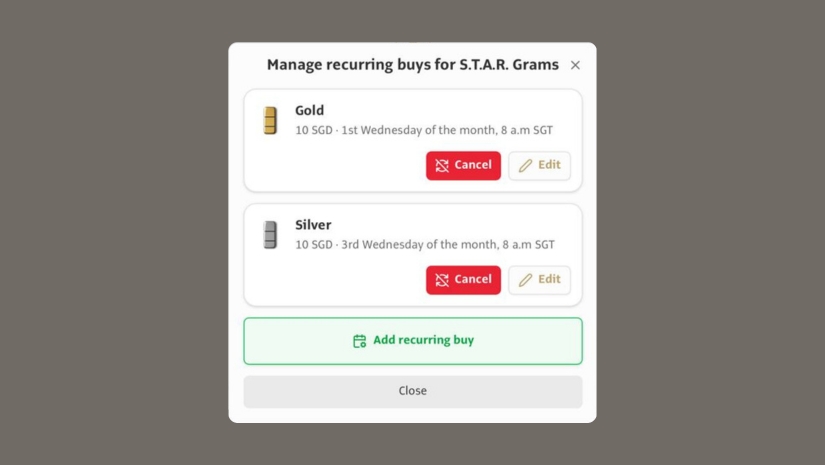
| You can now create and manage more than one recurring buy for S.T.A.R. Grams, making it easier to maintain separate recurring purchase plans for metals such as gold and silver. | |
| Each plan is shown individually with its recurring amount and scheduled purchase date. From the Manage recurring buys window, you can edit or cancel an existing plan, or select Add recurring buy to create another. | |
| Log in to your Silver Bullion account to view and manage your recurring S.T.A.R. Grams purchases. | |
|