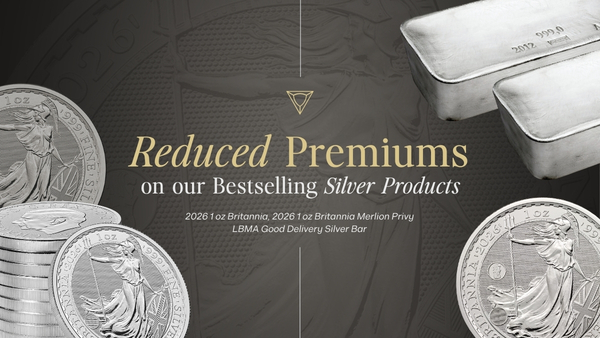
Physical Silver: When Paper Promises Meet Physical Reality

The Silver Institute's World Silver Survey 2026, released this month, captures the situation in a single line:
| "The received wisdom in commodity markets is that deficits don't matter, until they do, and the silver market last year confirmed that this holds true." |
For five years running, the silver market has consumed more metal than mines produce. The shortfall has been quietly bridged each year by drawing down above-ground inventories — until October 2025, when it stopped being quiet.
Market Structure
The LBMA silver free float — the physical metal genuinely available to settle unallocated positions in London — fell to roughly 136 million ounces in October 2025. Against that, London clears around 450 million ounces of silver per day in OTC trading. The physical buffer was equal to less than one-third of a single trading day.
What followed was not a normal market move. Silver lease rates exploded from their normal 0.3% range to nearly 40%, and shortly thereafter spiked to over 100%. The price surged from the mid-$30s in mid-2025 to over $50 in October, then to an all-time high above $121 per ounce in January 2026 — a near-300% rise from the year's lows, driven by a system unable to find physical metal to deliver.
Supply
The squeeze was contained, but only by airlifting approximately 48 million ounces of silver from COMEX warehouses to London — joined by additional flows from Shanghai and ETF redemptions. London survived.
But the Silver Institute already forecasts a 46.3 million ounce deficit for 2026 — meaning the bailout that kept the system functioning in October will be physically consumed within a single year. Above-ground silver is not being replenished; it is being shuffled between vaults and then drawn down. The massive paper-silver shorting in late January, which drove the price down from its $121 peak, did nothing to change this — paper selling cannot conjure physical metal into existence. As physical stocks fall further, moving existing inventory from one crisis to the next is not a fix. It is delaying the inevitable.
|
Key Insight
Paper selling cannot conjure physical metal into existence. Moving existing inventory from one crisis to the next is not a fix. It is delaying the inevitable.
|
Physical vs paper
The vast majority of silver "ownership" worldwide is unallocated — an unsecured claim against a financial institution, not a bar in a vault. The system functions like fractional reserve banking, with physical backing of net long positions believed to be an increasingly tiny fraction of notional exposure — though the actual ratios are not made public.
In normal markets, holders never ask for delivery, so the structure holds. October showed what happens when too many do. The 2008 financial crisis showed the same dynamic at the retail level, and was the experience that led me to found Silver Bullion: spot prices fell as paper traders liquidated, but physical silver simply disappeared from dealer shelves. I could not find silver to buy at any reasonable price — and premiums on real metal exploded.
In a true crisis, the premium of physical silver over the paper price reflects something specific: the perceived risk of default on the paper promises themselves. If a metal "bank run" begins in earnest, that premium will not be measured in single-digit percentages. It will reflect the market's assessment of whether the unallocated claim will be honoured at all.
Opportunity
Short-term retail demand for silver has softened, and premiums on coins and small bars have come down from their highs. After the intense physical demand in Q1 2026 — when sourcing metal became genuinely difficult and premiums on 1,000 oz bars surged to over USD 8 per ounce — we are now in a period of comparative calmness with decent availability of large bars. We are taking advantage of this window to lower our premiums and pass the benefit on to our clients. The fundamentals, however, have not changed.
Investors are quietly taking possession of physical metal — removing it from the pool that backs paper claims. Each ounce withdrawn makes the next squeeze closer. The next one will not have a comfortable cushion of COMEX inventory available to bail out the system.
The time to acquire physical silver is when it is available and premiums are low. That time is now. When the next stress event arrives, the gap between the price of physical metal and the price of paper promises can be far wider than it was during October's squeeze.
Sincerely,
Gregor J. Gregersen
Founder, Silver Bullion
| We are now vaulting in excess of 600 tons of silver for our clients in The Reserve — over 2% of global silver supply, exceeding the silver inventories of the Shanghai Gold Exchange. |
|